

Preface
PP, PE, PVC, and ABS are four mainstream general-purpose plastics in the global industry. Among them, PP food grade plastic is the most widely used safe packaging material for daily food containers. They occupy the largest production volume and the widest application coverage in the plastic and packaging fields. Many practitioners struggle with material selection due to similar basic plastic attributes. Each plastic material has unique performance advantages, price positioning and application scenarios. This guide systematically compares the four plastics from performance, usage and price dimensions. It focuses on analyzing the characteristics and application boundaries ofPP food grade plastic to provide clear selection standards for plastic raw material purchasers and packaging industry practitioners. All content conforms to overseas search habits and Google SEO inclusion rules, with standardized structure and core keyword layout.
1. Basic Overview of Four General-Purpose Plastics
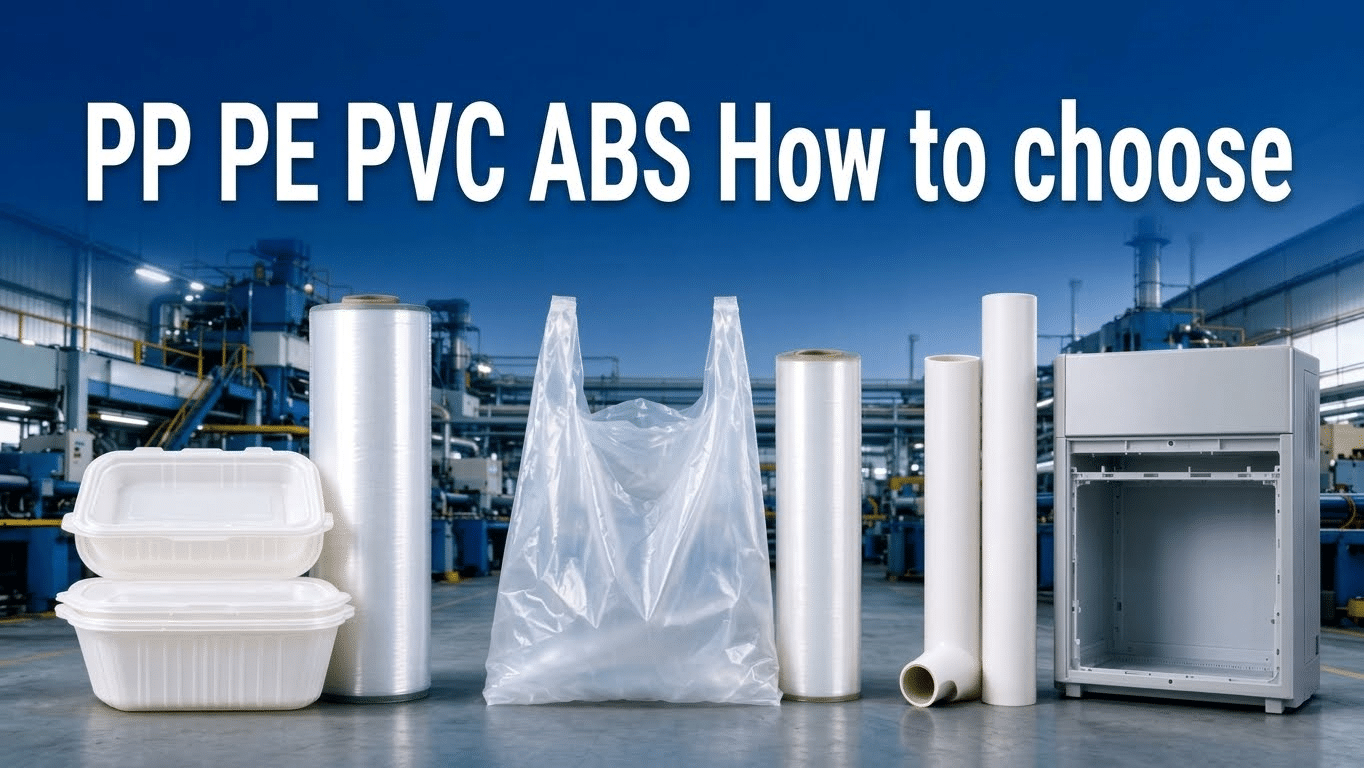
PP, PE, PVC and ABS are known as the “Four Major Plastic Families”. They dominate the global general plastic market with high cost performance and strong practicability. Each material has distinct characteristics and exclusive application fields. PP food grade plastic is the lightest and safest food-grade plastic for lunch box and food packaging production. PE features excellent softness and toughness, making it the best choice for plastic bags. PVC boasts the lowest price and outstanding durability, widely used for pipeline manufacturing. ABS has supreme hardness and surface gloss, specially applied to home appliance shells. Just like four professional partners, each plastic material has irreplaceable core advantages in industrial applications.
2. PP (Polypropylene): Lightest & Safest PP Food Grade Plastic for Food Packaging
2.1 Material Definition
Polypropylene (PP) is a thermoplastic polymer material formed by propylene monomer polymerization. PP food grade plastic refers to the food-safe PP material that passes food contact certification. It is a mainstream food-safe plastic widely used in daily food packaging and catering packaging industrial fields.
2.2 Core Performance Advantages
PP food grade plastic has the minimum density among all common plastics at 0.9g/cm³ with ultra-light weight. Qualified PP food grade plastic supports formal food-grade certification and safe high-temperature microwave heating. The material features stable chemical properties and excellent corrosion resistance without rusting. It has strong rigidity and good molding stability for precision food packaging product processing.
2.3 Material Defects
PP will become brittle and prone to cracking under low-temperature environments. It has average weather resistance and ages slowly under long-term sunlight exposure. Its low-temperature toughness is insufficient for cold-region professional packaging scenarios.
2.4 Main Application Scenarios
The core application of PP food grade plastic covers food packaging fields including microwave lunch boxes, fresh-keeping boxes and milk tea cups. Film manufacturing covers BOPP films and adhesive tape base films for packaging industry. Auto industry applies common PP materials to car bumpers and interior decorative parts. Daily necessities include plastic storage boxes and household wash basins made of ordinary PP instead of PP food grade plastic.
3. PE (Polyethylene): Softest & Toughest Flexible Packaging Plastic
3.1 Material Definition
Polyethylene (PE) is a thermoplastic polymer polymerized from ethylene monomers. It is the most widely used flexible packaging plastic in the global packaging industry.
3.2 Core Performance Advantages
PE presents soft and smooth hand feel with excellent flexibility and ductility. It has super tensile toughness and is not easy to break after stretching. The material features excellent waterproof and moisture-proof performance with zero water permeability. It has stable chemical inertia and adapts to most daily packaging environments.
3.3 Common Classification & Characteristics
HDPE (High-Density Polyethylene) is hard and rigid for plastic bottles and industrial pipelines. LDPE (Low-Density Polyethylene) is ultra-soft and suitable for food fresh-keeping film production. LLDPE (Linear Low-Density Polyethylene) has enhanced toughness for industrial winding films.
3.4 Main Application Scenarios
Flexible packaging covers fresh-keeping films, industrial winding films and various plastic bags. Pipeline industry uses HDPE materials for civilian tap water pipelines. Daily packaging includes express bags and shopping plastic bags. Daily chemical containers include shampoo bottles and pure milk plastic bottles.
4. PVC (Polyvinyl Chloride): Lowest-Cost & Super Durable Engineering Plastic
4.1 Material Definition
Polyvinyl Chloride (PVC) is a synthetic polymer material polymerized from vinyl chloride monomers. It is the most cost-effective general engineering plastic in the construction industry.
4.2 Core Performance Advantages
PVC has excellent chemical resistance against acid and alkali corrosion. It owns good flame retardancy and can realize self-extinguishing without continuous combustion. Its hardness is adjustable by adding plasticizers for hard or soft products. It has ultra-high durability and long service life for fixed facilities.
4.3 Material Defects
PVC contains chlorine elements with poor environmental protection performance and recyclability. It will decompose and produce toxic gas under high-temperature heating. The material is not suitable for food contact and high-temperature application scenarios.
4.4 Main Application Scenarios
Construction pipelines include civil tap water pipes and sewage drainage pipes. Building profiles cover plastic steel doors and windows and decorative profiles. Electrical industry applies PVC to cable and wire outer protective shells. It is also widely used in artificial leather, plastic flooring and architectural auxiliary materials.
5. ABS (Acrylonitrile Butadiene Styrene): High-Hardness & High-Gloss Appearance Plastic
5.1 Material Definition
ABS is a ternary copolymer composed of acrylonitrile, butadiene and styrene monomers. It is a high-grade general plastic focusing on appearance and structural performance.
5.2 Core Performance Advantages
ABS has ultra-high surface hardness and strong compression resistance. It features outstanding impact resistance and is not easy to crack after collision. The product surface is smooth with high gloss for high-grade appearance requirements. It supports electroplating processing to form metallic texture effect.
5.3 Material Defects
ABS is extremely sensitive to ultraviolet rays and turns yellow after long-term sun exposure. It has ordinary heat resistance and cannot adapt to long-term high-temperature working environments. Its weather resistance limits outdoor long-term application scenarios.
5.4 Main Application Scenarios
Home appliance industry uses ABS for TV cabinets and washing machine panels. Auto industry applies it to automotive interior decorative structural parts. Toy manufacturing includes high-precision building block toys like Lego. High-end daily necessities cover Dyson hair dryer shells and precision appearance parts.
6. Plastic Material Selection Guide for Packaging & Plastic Industry
6.1 Scenario-Based Material Matching Table
Food lunch boxes and fresh-keeping boxes prioritize PP food grade plastic for reliable food safety and stable microwave resistance. Fresh-keeping films and winding films choose PE for softness and ductility. Adhesive tape base films adopt common PP for stable film forming performance. Plastic shopping bags and express bags select PE for low cost and waterproofing. Water pipes and building profiles use PVC for durability and cost advantage. Home appliance appearance shells choose ABS for high hardness and high gloss.
6.2 Core Selection Logic for Practitioners
PrioritizePP food grade plastic or food-grade PE if the product requires food-grade safety certification. Choose PVC first when pursuing ultra-low production cost and strong durability. Select ABS for products needing high appearance gloss and structural hardness. Adopt PE for scenarios requiring softness, toughness and flexible stretching performance.
7. Summary
PP food grade plastic is the lightest and safest food-grade plastic specially used for food packaging and safe film materials. PE is the softest and toughest flexible plastic for various bags and flexible packaging. PVC is the most cost-effective durable plastic for construction pipes and profiles. ABS is the highest-hardness high-gloss plastic for home appliance and automotive appearance parts. Mastering the performance differences of the four plastics, especially the advantages of PP food grade plastic, helps industry practitioners select raw materials accurately. It effectively avoids material selection errors and reduces production and application costs.